Sunday, June 3, 2012

GROOVY GRANDMAS - OR NOT

Some thoughts on being a Grandma.

 I would like to start by saying ‘Hip! Hip! Hooray!’ for one of the most celebrated grandmothers of our times – Queen Elizabeth II, whose Diamond Jubilee Britons are celebrating this weekend.
(As you can see, the Queen, like me, favours purple, isn’t afraid to be white-haired, but that’s as far as I dare go with the comparison).


Once upon a time the only connection between a grandma and the word ‘hip’ would have been a replacement op. But time passes and things change, and groovy grannies of all kinds from ‘hip’ to ‘cool’ are now to be found all over the world, though quite a few traditional grans survive in quiet pockets of civilization..
In some cultures, grannies remain relatively unchanged, though the world – or Europe at least – has recently held its collective breath while watching the admirable efforts of a group of Russian babushkas’ to win the 2012 Eurovision contest.


In the event they came second, but in my opinion, their cheerful performance will be remembered with affection long after we have forgotten what the Swedish girl  (who won) looks like.

There are hip grannies out there, blogging away from Pondicherry to Arizona, from Spain to  Sydney, from the Greek Islands to the Outer Hebrides to the Outback and the Arctic Circle. Google ‘granny blogs’ and at least 30 million come up!
And they all have something interesting to say – not necessarily about cookie recipes and the cute sayings of their treasured grandchildren.
There are many, many granny recipes on the Web to be sure and quilting and crochet seem to come high on the list of granny accomplishments, but that’s not a bad thing. Somebody has to keep those precious skills and traditions alive, and who better than grandparents? 


Quilts by my sister - also a granny


Crochet by my daughter-in-law


Time can be an enemy, and forces parents to take short cuts and spend less time on telling stories and doing all the different voices.  drawing cartoons, teaching little girls to knit and little boys to make kites. Most grandparents, however, do have some time to spare and to spend on their grandchildren – a fact that my own father pointed out to me when explaining how much he loved being a grandpa. ‘Time to watch them learn and change and develop’ he said – ‘I never had time to notice how you changed and when.’


When I became a grandma for the first time, it was as if I took on a role I had always been waiting for.


My body was now the perfect shape for the accommodation of a baby’s needs, I slipped back into the easy balancing of a baby on my hip, burping it over my shoulder, persuading the toddler to eat with tricks its fraught mother had no time for –(open your mouth Mr Ferryboat, here comes a truck full of baked beans!).
Grandpas display similar skills -


But being a grandmother, while reviving maternal skills already acquired, uncovers new talents too. Like playing Angry Birds, and mending a broken Buzz Lightyear, or unravelling the strings of a marionette. (You can tell I speak from experience).
Quite simply being a grandmother is a unique human experience and I can quite believe that grandparents have played a major role throughout the centuries in the development of the human race and its cultures.
Grandparents represent safety to a child – their embraces are confident and comforting, their voices are reassuring, their patience is endless.
Phew – what a responsibility! But what a proud heritage.

These days there is pressure on grannies, as there is on everyone else, to be hip/cool/trendy/computer friendly/a Facebooker or a Tweeter.


In some countries, like Britain, America, Canada, Australia for example, today’s grandparents grew up absorbing change and moving with the times. But in countries like Greece and Turkey, let us say, where the past is far closer to the present and in some cases has never really gone away, the role of a grandmother can be very different.
Head of the family, the Greek matriarch, the Yiayia, expected children and daughters-in-law to kiss her hand when visiting her, and this custom still applied when I came here and married. Yiayia's word was law. In Corfu, many country grannies still wear head-to-toe black and sit in a corner giving orders and advice. Town grandmothers spend a lot of time at the hairdresser’s, dyeing their hair constantly lest one grey hair escape and become a badge of age. They dress smartly, deal in gossip, and lament the passing of the days when they were the ultimate matchmakers. 

The Corfiot country grandmothers used to – and in a few cases still does – look like this.


 My own grandma looked like this


Seen here with her daughter and two sons
 
While my mother-in-law and her own mother looked like this


But they all reflected the times in which they lived.

Today's grandma looks like anyone else - only the sensible shoes, the specs  and the  big handbags give them away.


As a grandmother of the 21st century, with a life spent in two very different cultures, I like to think of myself as neither over-traditional nor over-trendy. I appreciate the comfort of modern clothing and find it a relief that I no longer need to squeeze my feet into stiletto heeled shoes in order to be fashionable but uncomfortable. I don’t care.  I  sometimes feel I am attached to my computer by an umbilical cord, and I have tried reading with a Kindle and enjoyed that too but I feel no compulsion to be cool
Certain things defeat me now though – like getting into those irritating packages of pens and batteries, opening certain types of bottles. Fliptop cans are a blessing but childproof medicine packaging is not.
Well, no-one ever said life would be perfect.


Few grandmothers of my acquaintance now spend their  retirement grooming their cat and growing gooseberries, observing the neighbours from behind twitching net curtains or crocheting antimacassars.
Today’s granny is more likely to be writing a blog, buying books from amazon, selling antique clothing on eBay or diving for Roman wrecks in the Ionian Sea.
One granny I know of celebrated her 93rd birthday by going dog-sledding in Norway, another marked the occasion with sky-diving.

A British magazine recently ran a feature article describing the various categories of grandma, separating them into GlamGran, GoogleGran, WiseGran, GrannyGreenfingers, etc. I think that grandmas these days, are, just like their daughters and daughters-in-law, multi-tasking, independent  women, as much at home with an egg whisk as a harpoon or a Skype phone or a mouse.

Let’s not forget that grannies are not perfect, though. They have a fearsome reputation for interfering, for knowing best. They reserve the unassailable right to tweak and tug and criticize, to pull the hems of our miniskirts down, to cast disapproving glances at our hair and make-up, to switch off our mobiles. My grandmother, called for some obscure reason Ladgie, used to make me sit up on straight backed chairs, carry books on my head and would not allow me to whistle the Trumpet Voluntary or tap out with my fingernails the William Tell Overture in her hearing. Pity, because I was rather good at both. But Grandma ruled, OK?

Being a grandparent today can be a curiously liberating experience. No-one is quite sure what to expect of you now, so you can do anything you like and get away with it. The whole question of fashion, for example, becomes redundant. You can dress for comfort at last, with Velcro shoe fastenings, elasticated waists on pants and skirts, fur-lined Crocs and fleece tops, and the occasional; foray into high-camp retro evening wear. No-one dares to criticize any more, many, even, feel envious of your freedom.

Grandmas and grandpas are gone before you really appreciate them, gone before you have asked them all those questions about the family that in later years you will struggle with the Internet to unravel. When you, too, are a grandparent, you will wish you had asked while there was still time, why no-one ever talked about Uncle Charlie, or why one of the family names is French and means Christmas, or why Great-Grandma spoke Turkish, and why there is an old photo on Grandma’s computer of a girl in antique clothing who looks just like you.


My unforgettable grandma - Ladgie


Thoroughly Modern Granny
I have a little Granny, she’s really very old, but also unconventional in a most unusual mould. She doesn’t wear spectacles perched upon her nose, She’s into contact lenses and varnishes her toes. Unlike some other Grannies, who are home before it’s dark, She dresses in a track suit and goes jogging in the park. And when I wish she’d sometimes stay and tuck me up in bed, She’s off to study yoga and standing on her head. Some Grannies sit in rocking chairs and crochet shawls indoors, My Granny jumps upon a horse and rides across the moors. She goes on day trips with her gang, the over 60’s club, They racket round the countryside and end up in a pub! And on the homeward journey, like a flock of singing birds, They harmonise old favourites with some very naughty words! I love my little Granny, I think she’s simply great, If that’s what growing old is like, I simply cannot wait.

I do not know who wrote this but I find it very charming and very true,


Yoga gran

I'd like to close with a photo of my Dad, surrounded by his grandchildren, radiating happiness. It's not only grandmas who get all the fun!
 
.
                                  But -


Tuesday, May 15, 2012

IN THE SPRING, A GRANDMA'S FANCY TURNS TO THOUGHTS OF -

OF A NEW BLOG FOR MAY!
Young men may fancy something else, but grandmas have to diversify., from snogging to blogging...


Rough winds do shake the darling buds of May,
  And summer's lease hath all too short a date.

You’ve got to hand it to Shakespeare – he always got it right. Here we are in Corfu, today, with rough winds shaking the petals off the wisteria and jasmine, rain battering the roses and the fruit trees, reminding us none too gently that it is not yet summer. It’s always the same – the weather seems to wait for us who live here to have that first tentative dip in the still cold sea – but – hey!The sun is shining and the air temperature is high – let ‘s go for it before we all have to start work again.


The first charter flights arrive and May stays its hand, hiding a grin behind its hands filled with lilac blooms. Then the second wave of flights arrives, and things look promising again for the tourist business. Everything is freshly painted, the taverna chairs and tables are out, new awnings and umbrellas up, and beaches cleared of winter debris. Tour operator's reps have done their Health and Safety checks and opened up accommodation to find the occasional (who am I kidding ?) nasty, mouldy surprise.


The only people who don’t seem to be ready for business at this stage seem to be the boat hire operators. Do they know something we don’t ? Oh yes, they certainly do.

The merry month of may chuckles and chucks a couple of storms and a downpour of Biblical proportions (as the Greek news says, time after time) – and the early bird visitors are asked to grit their teeth and find consolation in the bright colours of the flowers and the emptiness of beaches. How can they not be empty in this weather ?


But though capricious, May is on the whole such a lovely month – no matter whether you live in Corfu, as I do, or in Britain, as several of my followers do. I haven’t yet experienced May in Canada, where my sister lives, but I am reliably informed that it should be Spring there too, unless a late winter is still piling up snow banks and freezing the Greeks – I mean creeks.
(Goodness this economic crisis does get to you.)
In the Southern Hemisphere, I believe, May is the equivalent of our November, but I do think, that, thanks to the power of beautiful poetry and prose, everyone, no matter where they live, can experience, at first hand or vicariously, the sheer loveliness of a May day.


Years of experience of Corfu in May make me cautious about putting away duvets and leaving off socks. ‘Ne’er cast a clout till May be out’ goes the old saying, and whether that refers to the may flower being in bloom, or to the month of May being over, I do not know or care. In Greece, May 15th is the day when public transport services go on to summer timetables, and the police and Armed Forces change into their lightweight summer uniforms – regardless of the actual weather. The old boys of Corfu still cling to their winter suits though, with knitted waistcoats, until the end of May.


May perhaps holds the record for the least known and most unusual name day. May 15 – St Paxomios.
Have you ever met  a Greek called Paxomios ? I certainly haven’t. and I was curious about this name.
Better-known, that is if you know of him at all, as Saint Pachomios, one website freely admits that he is one of the most obscure of all saints. Born in Egypt in the third century AD, of pagan parents, he served as a soldier in the Byzantine army and was so impressed by the behaviour of Christian prisoners that he converted to Christianity himself and became a monastic, eventually being responsible for the founding of twelve monasteries in the deserts of Egypt.


Looking up quotations is always a fascinating task, and one that easily leads one to digress.
And that is what I am going to do now.
Checking for quotes and trivia about May, I found this ironic comment :

‘The first day of spring was once the time for taking the young virgins into the fields, there in dalliance to set an example in fertility for nature to follow.  Now we just set the clocks an hour ahead and change the oil in the crankcase. ‘ ~E.B. White, "Hot Weather," One Man's Meat, 1944


Search engines working the way they do, searching for references to ‘May’ can bring up some unexpected offerings. I liked this one very much, eligible for inclusion in my search results only because it featured the word ‘may’ but impressive as a piece of advice to men on their relationship with a woman. It was written by Bob Marley – not perhaps the first person you think of in connection with marriage counselling but words of wisdom indeed.


“You may not be her first, her last, or her only. She loved before she may love again. But if she loves you now, what else matters? She's not perfect - you aren't either, and the two of you may never be perfect together but if she can make you laugh, cause you to think twice, and admit to being human and making mistakes, hold onto her and give her the most you can. She may not be thinking about you every second of the day, but she will give you a part of her that she knows you can break - her heart. So don't hurt her, don't change her, don't analyze and don't expect more than she can give. Smile when she makes you happy, let her know when she makes you mad, and miss her when she's not there.”
― Bob Marley

This seems as good a place as any to cease my May musings for today.
I leave you with two quotes from former President George W Bush and yes – they turned up during my search too.


#6: "Our enemies are innovative and resourceful, and so are we. They never stop thinking about new ways to harm our country and our people, and neither do we."
Bush's remarks video clipped in Washington, D.C., as he signed the Defense Appropriations Act for Fiscal Year 2005, on August 5, 2004.

#12: "The problem with the French is that they don't have a word for 'entrepreneur'"
comes from a remark made by Bush during a discussion of the French economy during the 2002 G8 summit in Kananaskis, Alberta, as reported in The Times (London), July 9, 2002

Makes you think, doesn’t it ?


Sunday, April 22, 2012

The Not-So Humble Dandelion


I couldn't resist this attractive gif when I found it on a blog to which I subscribe, called "Spydersden.

Funnily enough, or call it serendipity, I received on the same day, an email from my sister complaining about the number of dandelions swamping her Canadian garden.
This winter, there hasn't been as much snow as usual in Ontario - her garden usually looks like this -


and there is now in fact a bit of a drought with no snow-melt to swell all those rivers and lakes.
Ontario is a land of much water, a fact reflected in its beautiful  Native Indian tribal place-names.I make no apologies for referring here to a poem I knew by heart as a kid, and loved to recite with its repetitive but infinitely pleasing cadences - The Story of Hiawatha by Longfellow. Here is a brief extract that plays upon the beauty of those old names:

By the shores of Gitche Gumee, 
By the shining Big-Sea-Water, 
Stood the wigwam of Nokomis, 
Daughter of the Moon, Nokomis. 
Dark behind it rose the forest, 
Rose the black and gloomy pine-trees, 
Rose the firs with cones upon them; 
Bright before it beat the water, 
Beat the clear and sunny water, 
Beat the shining Big-Sea-Water.


But come what may, snow or no snow, rain or no rain, in April the hardy annual dandelions re-appear, in Canada, Cornwall, Corfu and China, and pretty much all over the world..


Dandelion - its English name comes from the French dent-de-lion, a reference to the jagged edges of its leaves.


 As kids, we were always told not to pick it or we would wet the bed, and indeed its common French name is pissenlit which  means just that.
To the majority of British gardeners it is a tiresome weed to be fought with nuclear weapons if necessary.
But to Greeks, it is a valuable food, there for the gathering in all the places where nutritious herbs and other plants grow wild, on sunny hillsides, in meadows, on any uncultivated land. Its bright golden head appears amidst the swathes of spring flowers, crowning a cluster of leaves and stems that are bursting with valuable nutrients.Spring is the best time to gather dandelions for eating, before the flowers appear, and indeed any other wild greens, with a re-appearance in autumn.


When I went to live at Kanoni, just outside the town of Corfu, after years of living in the town itself, I was stunned by the rich variety of plants, cultivated and wild, that burst into life in March and April each year.
To me, it was just a display of Nature's exuberant beauty, but to my mother-in-law, when she came to stay with us on a visit from Piraeus,  it was a glimpse of Paradise.

Like all Greek women, she had been brought up to value the plants and herbs that grew so abundantly in the countryside. Living in a city, she had little opportunity to get out and gather these freely available foodstuffs.
In Corfu, she was almost delirious with pleasure, and together we would set out with sharp knives and bags to gather  horta.

She taught me to identify many of the plants that could be eaten, as salads, steamed, sauteed or boiled, or as the filling in pies. Our expeditions were rewarding in every sense, and they brought us into a closer, warmer relationship. We found a way into an abandoned estate, where the old mansion had long ago disintegrated and been reclaimed by Nature, but where orchards and kitchen gardens had been left to their own devices and still flourished in a decadent, overblown way.


Two of the old Kanoni estates

We went home with bags of every kind of citrus fruit, with a great deal of horta, and with mushrooms and armsful of narcissus. We went, too, to the flat fields that surround the lagoon, heedless of the occasional aircraft landing not so very far away, our feet crunching on the millions of tiny snail shells that made up the springy surface below the grass and other plants. On the banks of the tributary streams that fed into the lagoon we found wild asparagus, wild celery and horseradish.
Sometimes we found ourselves searching the ruins of ancient Roman and Greek buildings, still not yet excavated - it is said that wherever you dig on the Kanoni peninsula you will strike an ancient building.

Ag. Theodora

Later, when my mother-in-law was too weakened by diabetes to come with me, I used to go out alone to pick horta for her. I was always joined then by Athina, a local woman living in what could only be called poverty, in a ramshackle shed, with her cows and sheep and goats, taking them out to feast on the lush Kanoni pasture every day. Athina was amused with my amateur horta-picking knowledge and did a great deal to encourage and teach me. She was an unmarried woman, the victim of the often cruel old dowry system - no dowry, nu husband. Despite her grimy hands and battered wellies, her grey hair and drab clothing, she was beautiful and had a classic grace about her that was worthy of the goddess for whom she was named.

My mother-in-law not only ate the boiled horta, she also drank the liquid it was boiled in, believing it to be good for her. Judging  by the quote from the Spydersden blog with which I am ending my own blog, she was right.

The Ancient Greeks knew the value of wild plants of all kinds, and used dandelion, which they predictably called leontodon, as a medicine for arthritis and rheumatism

When I was first married to my Greek husband, we spent a couple of years in England. I lived in a leafy suburb in Essex. as estate agents like to call such desirable habitats, and it was just a short walk from my home to the country lanes that were still not built upon. Dandelions grew there, leaves about 2 metres long it seemed to me, along with wild parsley, garlic and dill. I had learned that even the thistles had a tender heart that added its own flavour to the tangy mix of greens. I would walk home, the pushchair basket stuffed with loot, to be greeted by the neighbours with jocularity. 'You got rabbits, then,'
'No.' I would reply.' a Greek husband.'
That shut them up.

For those unwilling or unable to go horta-picking themselves, cultivated dandelions, if that is not an oxymoron, can be bought in greengrocers' shops and markets. There are several varieties, but they are all, as far as I know, called radikia.


They come neatly trimmed and bundled and require very little preparation. An easy way to obtain your dandelions, if you like, but for me nothing can compare with the pleasure of searching for the edible plants,bending down to inhale the satisfying fragrances of soil, moss and herbs, separating the tender young leaves from the tougher old ones. You learn not to mind worms and beetles and even spiders, and you begin to truly appreciate the variety and complexity of Nature.


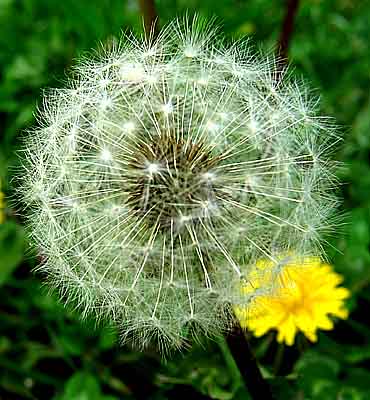
Just look at the dandelion clock for example, a cluster of tiny seeds on delicate, fragile parachutes, just waiting for a breeze, a passing animal or human, to assist in the distribution of those seeds far and wide. Simple? I think not. It gives rise to some very deep questions about how such efficiency evolved.
I recommend picking edible plants as a highly therapeutic exercise, one that challenges the brain and the back!.

Here is an extract from the Spydersden blog. that got me thinking (and reminiscing) about dandelion foraging.
" The ubiquitous dandelion, that perennial bane of lawn fetishists all across the land, is one of the healthiest food items on the planet. Instead of spraying it with herbicides every spring and thus saturating our lawns in poison that finds its way into water supplies, other plants, and the food chain, we should be feeding the dandelion to ensure its continued growth and the resultant nutritional values it provides.

According to the USDA Bulletin #8, "Composition of Foods" (Haytowitz and Matthews 1984), dandelions rank in the top 4 green vegetables in overall nutritional value. Minnich, in "Gardening for Better Nutrition" ranks them, out of all vegetables, including grains, seeds and greens, as tied for 9th best. Dandelions are nature's richest green vegetable source of beta-carotene, from which Vitamin A is created, and the third richest source of Vitamin A of all foods, after cod-liver oil and beef liver. They also are particularly rich in fiber, potassium, iron, calcium, magnesium, phosphorus, cobalt, zinc, boron, molybdenum, vitamin D, and the B vitamins, thiamine and riboflavin, and are a good source of protein.


Internally, dandelion is especially important in promoting the formation of bile and removing excess water from the body. The root decidedly affects all forms of secretions and excretion from the body. By removing poisons from the system, it acts as a tonic and stimulant as well. It cleanses the blood and liver. It is especially good as a blood cleanser for diabetes, dropsy, and eczema. Because of its high mineral content, it is used to treat anemia. It reduces serum cholesterol and uric acid levels. Lukewarm dandelion tea is useful for dyspepsia with constipation, fever, and insomnia.

Dandelion improves the functioning of the pancreas, kidneys, spleen, and stomach. An infusion of the fresh root is good for gallstones, jaundice, and other liver problems. For stomachaches, drink 1/2 cup of the infusion every 30 minutes until relief is obtained. The root is a specific for hypoglycemia. Take a cup of the tea 2-3 times a day and maintain a balanced diet. With a good diet, the root tea can eliminate adult-onset diabetes. The root tea will also help lower blood pressure, thus aiding the action of the heart.
Dandelion relieves menopausal symptoms and is useful for boils (taken internally), breast tumors, cirrhosis of the liver, constipation, liver and spleen enlargement, fluid retention, hepatitis, bronchitis, low blood sugar, and rheumatism. It may help prevent age spots on the skin. Serious cases of hepatitis have been cured with the use of dandelion root tea within a week or two when the diet is controlled properly and limited to easily digested foods.
The fresh juice is particularly effective, but a tea can also be prepared. Dandelion leaves are healthful as salad greens, especially in springtime. The roasted root is a nutrient rich coffee substitute."
And here is an interesting link.
 http://www.wildmanstevebrill.com/Plants.Folder/Dandelion.html

It gives an extract from the book


The link takes you to the excellent page on dandelions, but before you rush off and buy the only copy left at amazon.co.uk - read the customer reviews!


Apart from my own photos, I must thank my sister Katy, Frosso and Bob of Spydersden, for the use of theirs.


Sunday, April 8, 2012

EASTER IN CORFU


There is so much more to Easter in Corfu than bunnies and eggs and fashion parades. I hope the following will interest you – and maybe inspire you to join us next year!


This weekend it is Easter for the Western Church. Easter will be celebrated in the Eastern Orthodox Church, and thus here in Corfu, in one week’s time, on April 15. The dates of Easter are calculated according to different calendars by each Church – the Julian and the Gregorian, and this causes the difference in the dates of all other Christian festivals that arise from Easter, such as Lent and Whitsun/Pentecost. It can  fairly be said that Easter is the most important festival in the Orthodox calendar.


Here in Corfu there is a sizeable Catholic community that has existed since 1310. Today, the majority of the Catholics are of Maltese descent – their forefathers having been brought here by the British during the years of the Protectorate, as builders and agricultural workers.
By special dispensation of the Pope, permission was granted about fifty years ago for the Catholics of Corfu (and subsequently of other Catholic bishoprics in Greece) to celebrate Easter at the same time as the overwhelmingly Greek Orthodox population, for the sake of family harmony – a dispensation which to my mind shows an admirable sensitivity to the needs of minorities which could well be copied by others in today’s world of religion and politics.


Easter in Corfu is a great and wonderful celebration, a time when something quite remarkable happens every year. Strangers are welcomed to the island and into its homes, families come together again, the occasion is celebrated with great pomp, ceremony and reverence, and with traditions so old their origins are long forgotten. The meaning of Easter is not forgotten however, nor is it played down. The terrible fact of the Crucifixion, the agony, is there for all to see, in the form of the graphic images portrayed on the great Crucifixes in the churches, some of them carrying the Crown of Thorns upon them, others displaying a wreath made of flowers.


We do not only remember the horror of the Crucifixion, however, we remember too the joy and the hope represented by the Resurrection.
Throughout Holy Week, the TV channels play films with a religious theme; many people fast for that one week at least. And there is a sense of expectation, a waiting, for the release that comes with the declaration of the Resurrection, at midnight on Easter Saturday.
Devout, lukewarm, or disbelieving - no-one can fail to be drawn into the atmosphere of Easter in Corfu.

 One very attractive Easter custom, beloved of children especially, is to dye eggs red. Other colours are possible, but shiny red eggs really do symbolize Easter for most people. The dyeing takes place on the Thursday of Holy Week.


On Good Friday (Megali Paraskevi) I usually accompany my daughter to the home of friends who live next door to one of Corfu’s ancient monasteries. We sit and talk quietly in their lovely Corfiot garden, waiting for the bell to announce the exodus of the priests with the Crucifix and the traditional ‘Epitaphios’ or funeral bier, empty but decorated by the women and girls of the parish with fresh flowers from their own gardens. There is a choir, and for the next hour the parishioners will walk their parish, singing solemn songs. This is the day when we recall the Descent of Christ from the Cross.


It is a day of solemnity, of restrained behaviour and sombre clothing and ends with the Epitaphios procession in town, from the Cathedral, accompanied by dignitaries both religious and secular, the odd visiting celebrity, bands and choirs. The atmosphere is amazing – a huge crowd of people, standing quietly, with none of the uneasiness common to crowds in many of our modern cities.
But overnight something changes and on Saturday (Megalo Savvato) an almost irrepressible sense of celebration and joy is waiting to erupt. The day begins very early, with the strange and wonderful re-enactment of the earthquake that followed the Resurrection, according to the Bible – this takes place at the Church of the Holy Virgin Mary of Strangers in the town. Members of the church congregation shake and rattle the church furniture and stagger about in a vivid demonstration. There is then a procession in the town of Corfu on Saturday morning, in commemoration of yet another of Saint Spyridon’s miraculous interventions that saved Corfu from famine, and the magnificent Philharmonic bands are to be heard again.


At 11.00, there is an event that has become synonymous with Easter in Corfu, that attracts more attention than any other custom at this time, and yet is possibly of pagan origin rather than Christian. It celebrates the First Resurrection and is called the ‘botides’ in Corfiot Greek, this being the local name of the great clay pots that feature in the ceremony. .

 All over the island people throw pots and china out of their windows at this time, as a gesture to ward off evil spirits and bring good luck and happiness. In the town, however, everyone gathers at the spot called ‘Pentofanaro’, at the end of the Liston, where the tall old houses cluster tightly. The balconies are draped with crimson hangings, and filled with people who are balancing huge clay pots, filled with water, on the railings. There is a buzz of excited anticipation and then, precisely at eleven, the pots are dropped and hurled from above, to shatter on the street below. 


Immediately afterwards the bands trot through the alleyways at a run, playing appropriately allegro marches.
The islanders spend the rest of the day preparing for the feasting of Sunday, while visitors enjoy seeing old friends or exploring the island which looks breathtakingly beautiful at this time of year, garlanded with wild flowers of impossible variety.


For as long as I can remember, we always went in to Corfu Town, to the Esplanade, to witness the declaration of the Resurrection by the Archbishop with the impressive firework display that follows. The size of the crowds, the absence of parking anywhere near the centre of town, having toddlers who inevitably fall asleep and have to be carried, means that our family now usually joins in the celebrations outside town. If it is at all possible to attend the celebrations in the centre of town, it is an experience never to be forgotten. 
With the announcement of the Resurrection ; Christos Anesti! - by the priest, candles are lit, kisses exchanged, and then there is a spectacular fireworks display , now set off very professionally, but I do remember one year, a long time ago, when the setting off of the fireworks was the task of the military, most of whom were National Servicemen of limited experience. Their calculations were off, and rockets hissed and snaked their way across the Main Square at ground level, exploding at people’s feet. Luckily there were no major injuries and these days our firework displays are properly performed high in the sky.


Immediately after the Resurrection ceremony, most people go home or to a restaurant, ostensibly to break the fast of Holy Week, with a meal beginning with the traditional Easter soup called Mayeritsa. Made from finely chopped offal, with masses of lettuce, dill, spring onions, and lemon, and sometimes finished off with egg and lemon sauce stirred in, it is so delicious that we always wonder why we don’t make it more often.


Everone tries to get home with their candles still alight, and it is customary to daub the sign of the cross on the door lintel with the flame of the candle.


Our family always spends Easter Sunday together, as indeed do most families in Corfu. We roast a lamb or a goat as well as a selection of other meats and sausages, and there are salads and dips and jacket potatoes done under the spit that invariably get forgotten in the excitement and end up as inedible and carbonized. The wine flows, the red eggs are cracked with everyone trying to have the one that beats all the others. The roasting and basting, testing and carving, of the meat is very much the province of the men on this special day.


It was a slim lamb that year!


My son bakes a wonderful choice of bread, my daughter produces a bowl of tzatziki big enough to feed an army, and everyone who joins us brings a contribution. We have a very cosmopolitan group of friends, and some of these dishes are truly exotic. In spite of appetites honed by a varying number of days of fasting, there is always plenty left over to provide the basis of meals for the next few days and the dogs enjoy a bone-fest of their own.


There are so many Easter traditions that make this event such a memorable occasion. New clothes and shoes are bought, especially for children, with god-parents expected to foot the bill, as well as for the elaborate ‘lambades’ (decorated candles) that the child will take to be lit at the Resurrection ceremony. These days commerce enters the picture with Barbie-themed candles or Toy Story or whatever other kids’ tie-in toy is currently popular.
There are special sweets and cookies for the occasion, and in Corfu, sweet bread decorated with a red egg and feathers, called a colombina, is a reminder of the Venetian period of Corfu’s history.
When I was first married, I found myself, a few days before Easter, with my mother-in-law and two sisters-in-law, all up to our elbows in dough made with olive oil, sugar, flour and vanilla. These ingredients were mixed in a huge earthenware bowl, very old, kept especially for this purpose and stored for the rest of the year under clean cloth. Under Grandma’s beady, critical eye, we kneaded and mixed until she was satisfied, then shaped the dough into twists and plaits, circles and knots, and placed them in neat rows upon enormous metal baking trays, which were then taken, in convoy, to the local baker to be baked. A kind of shortbread, the quality varied from household to household, the best being like shortbread, the worst like sweet concrete. It was the custom to distribute them amongst family and friends. They were called ‘koulourakia’, koulouri meaning a circle, and are still very much part of the Easter menu..


My life in Greece can be measured in Easters, each one of them a memory of what it means to be part of a loving family, Anglo-Greek style.

HAPPY EASTER EVERYONE!

Some of the photos are my own, others appear by kind permission of Aleka, Joanna, Frosso, the Corfubloggers, and Julie.