Showing posts with label corfu greece. Show all posts

Monday, August 13, 2012

CHASING THE CHILLOUT FACTOR


I’m doing my best to cope with the heat and humidity that have had the thermometers shimmering for weeks now.
I suppose there are people who enjoy it, but our cat is not one of them, though he looks pretty comfortable in the photo below.


Kat does, however, set an example on how to cope with great heat. He pretends it isn’t there and  slinks from one patch of shade to another, pausing for a sip of water, mooching from one meal to the next, no longer bothered by his hormone-related instincts since he had the chop. He is  apparently not in the least put out by having to wear a black and white fur coat that covers him from nose to tip of tail.
Young humans, however, seem to find the heat a massive turn on, and Corfu’s beaches and clubs throb with bare, tanned bodies and pulsating music and 24-hour displays of plumage and agility and whatnot that rival anything the animal world can come up with.
 
I envy their energy and stamina. I had it once too.
Now, however, I tend to cool down with a good book.
I like ‘cool’ titles and I am currently reading ‘Arctic Chill’ by an Icelandic writer called Arnaldur Indridasin. I’ve recently read ‘The Ice Princess’ by Camilla Lackberg and ‘The Snowman’ by Jo Nesbo. ‘Northern Lights’ by Nora Roberts was set in Alaska in winter, and the Inspector Frost books are a must-read. Canadian writers are, as you might expect, up there with the best when it comes to writing snowy crime novels – a favourite of mine being Giles Blunt.


I heard somewhere about something called ‘cold reading’ and of course visualised a list of cool books, but according to Wikipedia : Cold reading is a series of techniques used by mentalists, psychics, fortune-tellers, and illusionists to determine or express details about another person, often in order to convince them that the reader knows much more about a subject than they actually do.[1] Without prior knowledge of a person, a practiced cold reader can still quickly obtain a great deal of information about the subject by analyzing the person's body language, age, clothing or fashion, hairstyle, gender, sexual orientation, religion, race or ethnicity, level of education, manner of speech, place of origin, etc.

This of course led me to think about our very own Mentalist, aka Simon Baker, 


But thinking about this rather hot man melted the ice in my frappe coffee so I quickly desisted.

My own favourite film featuring snow – and the wonderful Frances McDormand – was ‘Fargo’ but for sheer silly snow-filled fun I always loved Dumb and Dumber, that needs no other description other than the fact that it starred Jim Carrey and Jeff Daniels    and Cool Runnings, about the Jamaican bobsled team’s attempt to get into the Canadian Winter Olympics – hilarious.

 Frances McDormand in 'Fargo'

(What about those Jamaican sprinters though – it’s no joke, winning at the London Olympics.)

Daily Mail photo

Phew! All this mental effort calls for a cold drink and the choice is between a perfect gin and tonic, in a tall class dripping with condensation, having been kept in the fridge, along with the gin bottle itself. And a tall glass of coffee frappe, The secret with frappe is not to drink it too quickly – as the ice cubes melt and the foam turns back to liquid, the frappe satisfaction level lingers on.


Meanwhile I’ll listen to some chill-out music – plenty of choice there, including the slightly unlikely combination of African, Indian and Asian chill-out tracks.
 
I have very few wardrobe problems in August – retired, I don’t go far, and literally live in sarongs and flip-flops.  Knickers are optional and depend on whether I am expecting visitors or not.

Yes – it really is THAT hot!

Think cool food – salads, iced soups, fish, water melon. Greek food has a surprising number of cool dishes and the fact that several of them are based on summer vegetables cooked with olive oil means they can be eaten cold or tepid without the horror of congealing fat. Lemon squeezed over everything is another cool move. Think briam and tzatziki, horta and lemon, fresh green bean salad. Think feta and water melon salad, cheddar and grapes. (Hey – reminds me, you can now get fantastic English Cheddar in Corfu – cheaper than many other cheeses, tangy and crumbly -  I* will just pop and check the fridge..)


One of the grandchildren had his sixth birthday this week. There was much head-scratching over how to keep the energetic kids (who in a few years will be leaping about the beach-bars and clubs) amused but not out of control. How to entertain them without permanently alienating the neighbours?
Water was of course the answer in this weather and we set up a kids’ slide and a large paddling pool and let them loose. Huge success!


I read a web article on how to keep cool at home in great heat. It suggested covering all fuzzy surfaces like carpets and upholstery with white cotton sheets and abandoning clothes entirely inside your own house. At night, use a small pillow that has been in the freezer for a couple of hours.
Also sound, if chilly, advice. Other tips I have followed have resulted in me typing this blog wearing a wet tee-shirt with my feet under the desk, in a bowl of cold water.

Hey! It works!

Stay cool everyone.

You didn't think I would show you my own tootsies in a bowl of water, did you?

Having 'penned' a blog about the heat, chances are it will now rain. It's like washing the car or watering the garden - a guaranteed rain-dance!


Friday, August 3, 2012

THE DOG DAYS OF SUMMER

CountyKate on High Summer in Prince Edward County, Ontario


The phrase, 'The Dog Days' stems from the ancient Roman period, when it was  believed the Dog Days 'brewed evil, The Sea Boiled,  Dogs Grew Mad, and made all others languid'.  The Days begin on July 3rd and end on August 11th - 40 days without rain. Of course, with the Gregorian, or maybe the Julian calendars, its all screwed up , and poor Sirius gets the blame anyway,  Sirius being the Dog Star.

When I first began composing this blog. about The County, in July we were suffering a severe drought.

If you remember, The County is an isthmus, or the 'Stickyout Bit' as my granddaughter says, into  Lake Ontario.  Situated as we are, much of the forecast precipitation bypasses us, drenching the mainland to the north.  So we have not had significant rain  for several weeks, and all those lush fields of maize and sweet corn I described  last time, are shrivelled and brown.


The farmers have frantically harvested the cereal crops, two weeks early in fact, and baled the stalks to take to the local Mushroom Farm, that uses them for their growing beds.  Dark, moist sheds, where the workers harvest on their knees, eight hours a day.

But the diligent farmers are providing us with seasonal produce, fruit and vegetables, for canning, freezing or jam making,. If it’s fruit, I’ve eaten most of the punnet before I get home!


Despite the heat and humidity, we can occupy ourselves with a variety of delights. On these endless, hot  summer days, we can visit antique shops, enjoy the annual quilt show; garage, yard or barn sales; the wineries to visit, the cheese-making factories, small enterprises now compared to the industry of the 1800's, along with canneries and beer-making!

Paddling a canoe is fun and harks back to the old days.

   canoes for rent

Then there is sailing, fishing, kayaking –


Or else we can stay at home, under the spreading maple trees in our shaded gardens and sip wine or beer, read, sew or daydream.


We might follow our forefather’s trails, to go Up North, to the cottage, boat or trailer, to live a more Spartan life for a while, experience the Great Outdoors.

Cooking in cramped conditions!

Who were these first settlers?

They started arriving in the early 18th century. Some were farmers, from England, Scotland, Ireland or Wales. Some were soldiers, pensioned off with an acreage of land, and enough supplies for two years - seed and livestock. Yet others were the sons of aristocratic families, shipped off with an allowance for various reasons. Few of them were prepared for the hardships. While some of them moved into established settlements, many of them literally had to hack a clearing out of the virgin forest and build a log or sod cabin.
 There were many religions represented too - Lutheran, Baptist, Presbyterian, Roman Catholic, Anglican, Quakers and others.
They would have built their churches probably at a crossroad of tracks, and later came settler’s cabins, a tavern, a store and businesses.

Not only farmers came; where they settled, they needed carpenters, millers, if near the Lake, shipwrights.  The women brought their crafts too, cheese-making for instance. Once they had made cheese for the family needs, then it became a bartering agent, then grew into an industry. In the mid 1800's, there were 30 cheese-making factories on the County.

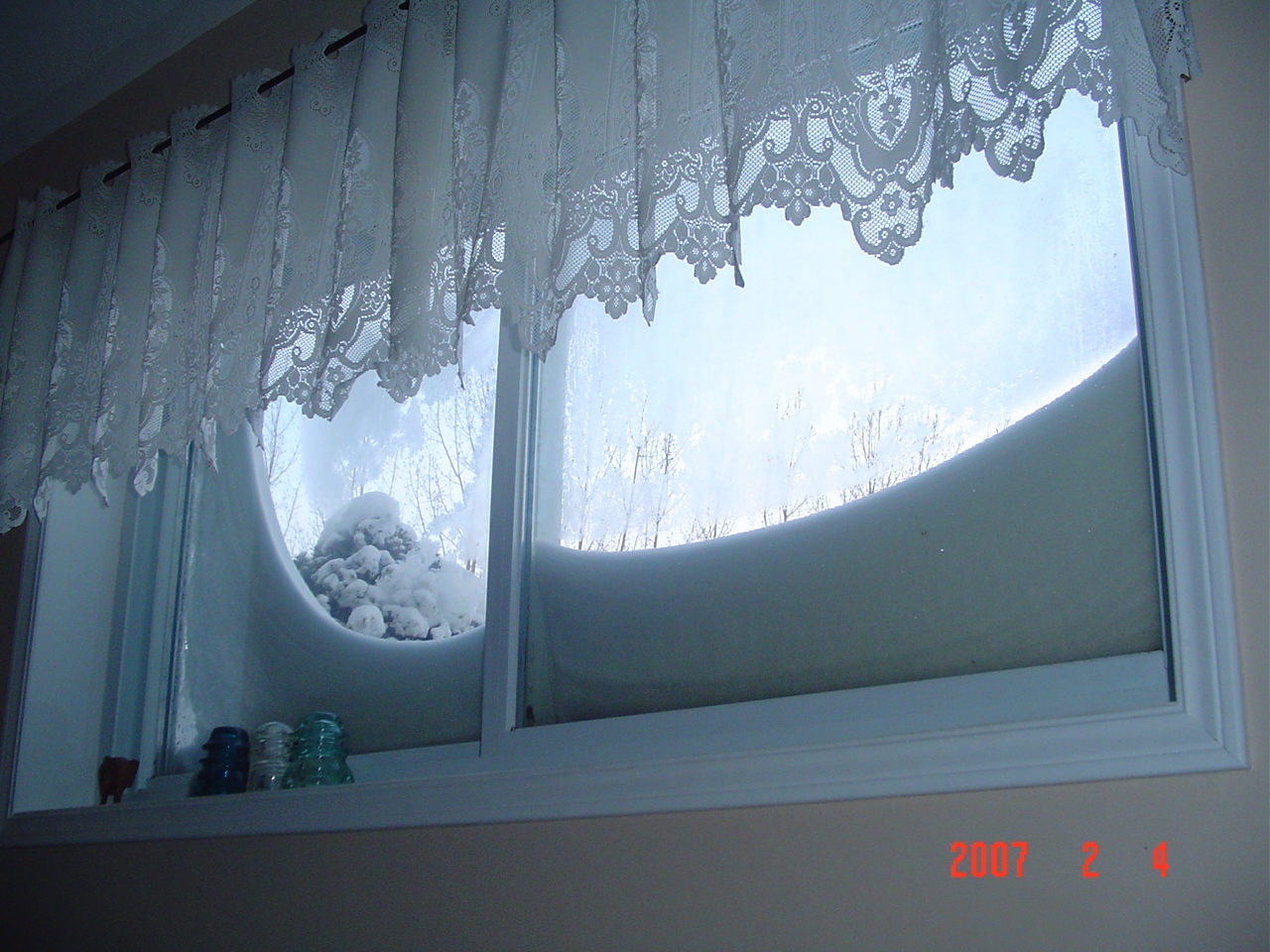
Winter for the pioneers must have seemed endless.  No contact with neighbours, until Spring melted the rooftop high snow drifts.

Snowdrifts piled against the windows

Heavy horses, still bred here on the County, cleared a passage to the hamlet; going two abreast, the waggoner standing on the platform of his wagon, whistling and encouraging the amiable creatures.


A barn-raising - well, to be honest, a barn-razing, but you get the idea

But spring meant social gatherings. It might begin with a barn raising, all the neighbours and their wives and families would gather for this two day event, which led to Basket Lunches; Pie Sales, Church Sales; Quilting Bees , Swapmeets for clothes;  but also these gatherings were for weddings, christenings and funerals.  The harsh life took its toll, and folk were laid to rest, in family plots, village cemeteries or grander graveyards.


Old and young, infants and children put to rest in shaded places, sheltered by those same maple trees, often surrounded now by wild lilac hedges too. 
 So much lilac grows wild now, we have a Lilac Festival.


Many pioneer women brought with them on the sailing ships from England, 'slips' of lilac from their beloved homes, tended carefully on the voyage, they were then planted by the door of their cabin.  Driving around, if you see a clump of lilac growing wild, look closer, there's probably the foundations of a settler’s home, maybe the barn nearby

So we arrive back to our modern pioneers. That part of the population that goes Up North, or maybe to my County, there to encounter aspects of the life their forefathers experienced.

Wildlife comes to mind! We have seen, at various rented cottages, coyotes, raccoons, skunk! There were deer one early morning, a family of three, grazing on our front lawn. Another time, a skunk family emerged from underneath the deck, in line abreast, mom, baby, baby, baby, pop.  Don’t frighten them, or they WILL spray you!

Raccoons are charmers, cute little bandits faces and dinky little hands. But they are scavengers, as my daughter can tell you.  They come at dusk, to root noisily through unsealed garbage;  or as my daughter found out, alerted by the loud chomping noises from outside, to eat the dog’s supper, from her bowl, while dog slept peacefully inside!


The coyotes are rarely seen, but at night, an eerie 'yip, yip, yip', cuts the air, as the pups call for momma and food.

Then of course we have bears. Yes really.  Hang your food in a bag in a tree. Dispose of human smelling waste in a pit in the ground! If it’s a brown bear, rear up and make big, if it's a black, crouch down and make small. Who is going to hang around long enough to find out? Anyway, my daughter would frighten them away with her screaming.


But the lucky modern visitor to our County has much to see and do whilst here.


There are Maritime Museums; Emu and Llama Farms.  The soil is conducive to grape growing, from a few large, commercial enterprises, to many small, family owned and tended, and of course, imbibed!
There are Wine Tasting tours -better use a driver - or Honey and Lavender Farms for another taste of local products.

Local vineyards

Local  ice-cream shop

We have our own  local ice-cream producer - Slickers -  or try one of the many locally harvested Maple Syrup products.

You could take in an Art Tour and admire local artists’ paintings – and plantings!


Visit antique shops, like 'County Traders' where Trader John boasts secondhand furniture, with stock changing daily or 'Dead People’s Stuff' where Sue recycles collectables from the past.


But finally, after all this touring and tasting, and the activity is over till tomorrow, come back home, to sip local wine or beer, eat locally made treats; all under the shade of those maple trees, and doze into  the dusk.

Prince Edward County 2nd August 2012 

(Almost all the photos are my own)


Sunday, July 1, 2012

FROM A SHIP'S BLOG


 A gentle jaunt along the sublime north-east coast of Corfu


No, these are not photos from Thailand or the Caribbean - they are from the northeast coast of Corfu where I am fortunate enough to live.


Is there anything more relaxing than a leisurely cruise along a beautiful coastline in a boat that is small enough to get into the nooks and crannies of a rocky shoreline?
That is, as long as you are not under the command of a skipper who thinks he is Captain Bligh.
Fortunately ours is always pretty laid-back and his only desire is to please his passengers. As my son, I suppose he has to treat me as a cherished client, but I do not hesitate to recommend him here, not only as a skipper, but as the proprietor of one of the best boat chandleries in Corfu - Boatman's World at Kontokali! He and Joanna know their stuff!


Row, row, row your boat,
Gently down the stream.
Merrily, merrily, merrily, merrily,
Life is but a dream.

 However you choose to interpret the words of this old rhyme, there is no denying that to sail, if not actually row, along the north-east coast of Corfu is to sail into a dream. And not only into a dream – into a reminder that we are never quite done with the past.
Corfu was a part of the Venetian Empire for almost 400 years, and today we cannot but recall that fact wherever we go on, or around,  this splendid island.

You may think that you know Corfu, but until you have sailed along its shores you cannot truly say that. Yachtsmen say that the coastline of Corfu is one of the most beautiful in the world and few would argue with that. There is such surprising variety in its scenery, such a pleasing harmony between the work of Man and of Nature. Seen from a small boat, the most blatantly ugly modern hotels (of which we have remarkably few in Corfu) are reduced to a regrettable but forgettable blot on the landscape, while the grace and charm of older buildings put things into perspective.
Now is the time to make such a journey, before the bays and coves of Corfu become cluttered with pleasure-craft, before the water-side tavernas become crowded, before the beaches lose their sparkling innocence.
It is the ideal way to escape from the heat, and if you are not lucky enough to own your own boat, then borrow one, rent one, or wheedle your way into some skipper's heart and persuade him to take you with him.

Come with me, and let’s sail merrily into that dream..

We could set off this time from the town of Corfu. We did so on a Benetteau Oceanis 461.


Lying off the east coast of Corfu, visible from the town, are two small islands – three if you count the solitary slab of rock called Brouzada. (It is also called Kaloyeros (Monk) by the locals, or Punk Rock by some of the British, as it appears to have a tuft of punk-style hair atop its otherwise bare rock.) Many a less-experienced sailor, taking part in one of  the regular off-shore races, has been led astray by the sheer sides of the rock and run aground on the shallow reef that lurks below the pale, tell-tale aquamarine sea that surrounds the rock.


The other two islands are called Vido and Lazaretto. Despite their small size, they carry an enormous amount of historical weight and human tragedy  upon their pine-clad shoulders,


Beach on Vido

Vido, in Venetian times, was connected by tunnels with the town of Corfu, and convicted criminals, after trial in the town, would be led via the tunnels to imprisonment on the island.


 In the eighteenth and nineteenth centuries, it bristled with fortifications, Venetian. French and then British. But on the ceding of the Ionian Islands to Greece, the British blew up almost everything on the island, including a very ancient Byzantine church. Today, massive chunks of masonry are largely hidden by the abundant foliage of the island’s many trees and bushes. Rabbits, goats and pheasants, a reminder that this was for a while a Bird and Wild Life Sanctuary, roam freely and are quite tame. Vido was for a time a reformatory and as such was out of bounds, but now it welcomes visitors with its beautiful, tranquil scenery and unspoilt beaches.
It is perhaps best known for its Serbian Mausoleum and monument, commemorating the Serbian soldiers and civilians who were hospitalized on the island in 1915, many of whom subsequently died there.


The even smaller island of Lazaretto, also has a tragic history. The Venetians established a quarantine station here, for ships bound for Corfu. They were the first to establish the quarantine system, in the fifteenth century, and their stringent rules did much to lessen the spread of the plague epidemics that rampaged across Europe in those times. There was also a ‘leprosarium’ on Lazaretto, where victims of contagious diseases such as leprosy would be confined.
During the Second World War, and also between 1947 and 1949, a great many Greek Resistance fighters and political prisoners were executed on the island.


Hidden amongst mature trees, on the Corfiot hillside overlooking Lazaretto, is one of the famous ‘Durrell houses’, so-called because in the nineteen-thirties, the Durrell family rented it for a time, and Gerald Durrell wrote about it in his much-loved book, ‘My Family and Other Animals’, christening it ‘The Daffodil-Yellow Villa’.
Like so many of the old houses that remain along the Corfu coast-line, it dates back to Venetian times.


View of Lazaretto from the Durrell villa

Not far from this villa, is Sotiriotissa, with its old church  and attached house. Here the main road leading north out of Corfu Town turns inland, but the coastline continues in a series of small beaches backed by tall trees in which some outstanding examples of Venetian domestic and sometimes fortified architecture remain, many of them still occupied, some beautifully renovated.

Sotiriotissa


Krevatsoula


Old houses and churches on the shoreline

It is here that we find Kontokali and Gouvia – well-known these days as holiday resorts, though the fortunes of Kontokali have declined noticeably, perhaps because the busy dual carriageway  discourages timid tourists from crossing it. The village is now dominated by the yacht marina, but there are still areas that look just as they always did, such as Gerekos island – not really an island but with the sense of separation from the mainstream that is the joy of island life. The men of Kontokali were always seamen and fishermen, and they still fish here, and mend their nets, maintain their boats and are closely monitored by hungry gulls and herons.


Gerekos Island


Govino Bay, enclosed by Gerekos island and the Kommeno peninsula, and the site of the large yacht marina, is a huge, safe anchorage, where the Venetian navy gathered its ships, and closed off the narrow entry with a great chain, which could be raised and lowered as required. Ruins of watchtowers and other naval buildings can still be seen, including the Venetian arsenal and dockyard at Gouvia, now a pleasant and popular little holiday resort.


  Venetian shipyard at Gouvia


Passing the little church of Ypapanti, a favourite venue for weddings and baptisms thanks to its photogenic appearance, we sail up towards the sparkling bays and coves formed where the limestone slopes of Mt Pantocrator meet the water’s edge.
Continuing northwards along the green, wooded shores, the idea that Corfu is ‘spoiled’ by tourism seems very far-fetched. Clusters of villas, apartments and tavernas are strung along the coast, dwarfed by the dense olive groves that give way here and there to the glittering crags and outcrops of Corfu’s highest mountain, Pantocrator.


Elegant villas abound, the older ones  screened by Mediterranean gardens brimming with palms, jasmine and bougainvillea.
There are houses that could not be closer to the sea, that were once fishermen’s huts, olive presses or olive pickers sheds- now so coolly glamorous that they frequently grace the pages of glossy magazines.

For example - 


.


The residences of modern, international giants of commerce, politics and the media draw the eye and perhaps arouse some envy, but even the longest lenses of the paparazzi are rarely able to breach the privacy  - that they offer gracious living by the sea is obvious, but who enjoys it is less easily observed.
Not all the Venetian buildings that dot the coast of Corfu started life as domestic residences. Let us not forget that in those days there was no road along the coast, and that pirates infested these waters, not to mention the successive waves of invaders . Many of the buildings that are now homes or tavernas, for example, were once staging posts for the boats that plied the coast, carrying passengers, freight and mail. Some simply provided seasonal accommodation for the olive pickers, who brought the crop to the shore to be pressed and shipped, in those days back to the relentlessly greedy merchants of Venice. St Stephano, Kaminaki, Agni and Kalami are testimony to these origins. 

View of Agni Bay

Most of the ancient villages were built high upon the hillsides overlooking the coast, their dwellings clustered tightly about each other, interspersed with narrow, twisting alleys and high walls to deter the marauders.
The closer to the shore a ‘modern’ villa is, the more likely it is that it started life as a functional building of some kind, usually an olive press.

There are several churches too, down at sea-level.
Perhaps the most famous (Lawrence Durrell write about it) and the most spectacularly-sited is the tiny chapel of St Arsenius, below Kentroma village.


I love Durrell's description of throwing cherries into the crystal-clear water nearby, and his wife               Nancy diving for them .

But the great white house that seems to rise out of the water itself at Kouloura, was a fortified Venetian lookout post. It was occupied by German troops in WWII for similar purposes, and its owner, an elderly lady, refused to leave her home and was allowed to remain, interned in one of the towers.  Wrongly identified by many guides and guidebooks as Lawrence Durrell’s temporary home, it now belongs to an influential Italian family.

 Kouloura

The White House that was indeed Lawrence Durrell’s home for a time from 1936  still stands at Kalami, and is still available for rent. Its simple furnishings have changed little from Durrell’s day and include his writing desk. Much has changed at Kalami, but The White House retains a charm and an allure that represents the very best of the traditional Greek island holiday. The terrace of the building houses a Greek taverna where wisteria droops above the tables in April and May, where the view is of boats and ducks, swimming merrily if implausibly, between the small boats..

The White House at Kalami


Another of the most famous villas along this coast is of course that on the Rothschild estate. Its design could be said to hark back beyond Venetian times, perhaps to an Angevin stronghold?

Spotting the celebrities that visit each summer, when they emerge for a taverna supper, is a popular holiday pastime for holidaymakers in this area.
But more about the pleasures of a meal by the sea another time.

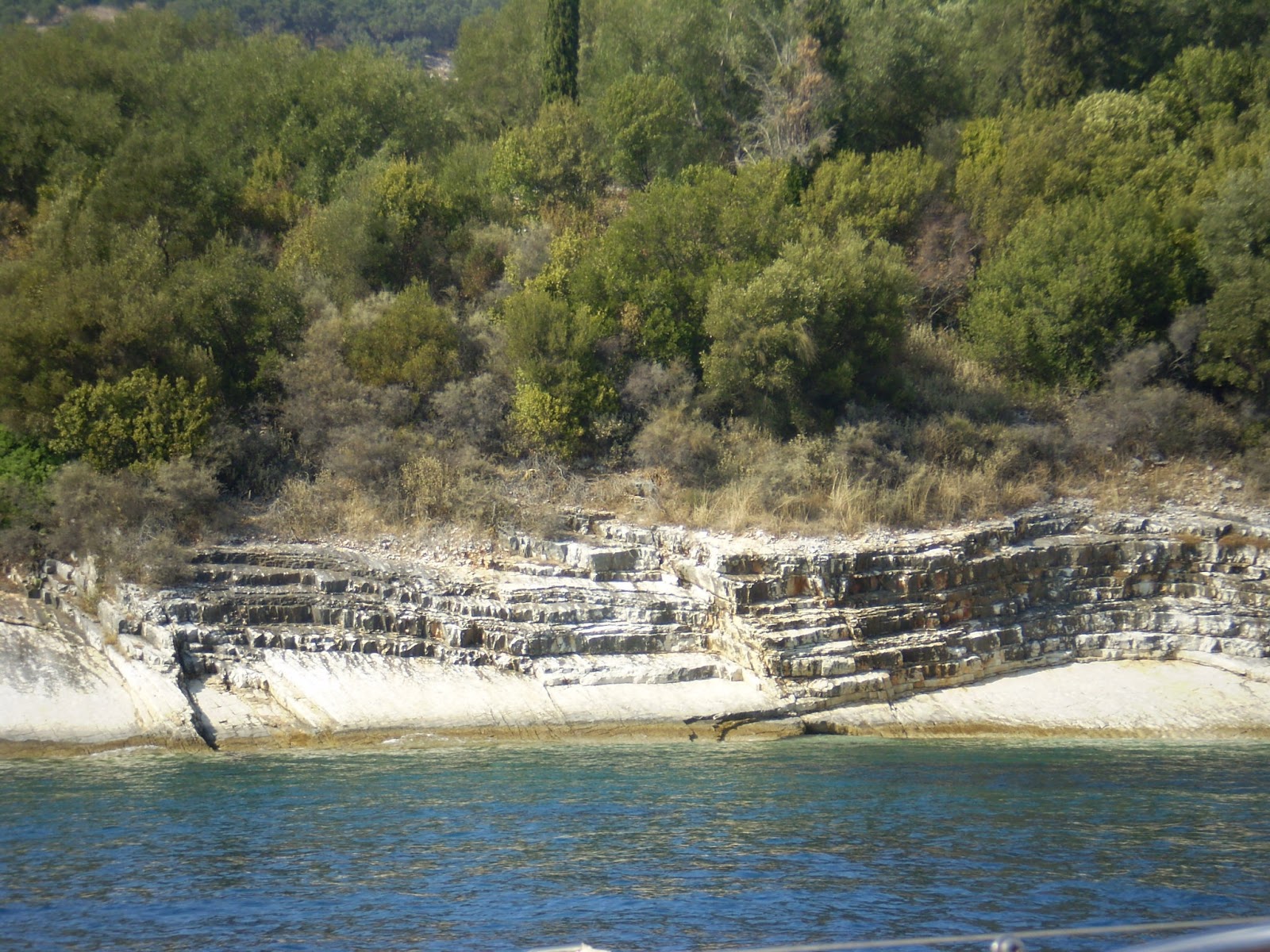
It is not only the creations of Man, however, that attract attention while sailing along past cliffs and coves, caves and beaches. The rock formations themselves are astonishing, hinting at primeval upheavals we can barely imagine.


Historical facts. rumour, intrigue and downright gossip – all have been borne on the sea breezes of this lovely and historic coastline.

So, row or sail or gently cruise your way up and down the coastline where history has been made in the past and continues, from time to time, to be made today.

 You could even surf it!

Or swim it!

I do recommend you read, or re-read, 'Prospero's Cell' by Lawrence Durrell for poetic descriptions of this coastline as it was and as it remains - utterly beautiful, utterly magical.


Thanks to my friend Frosso and to my sister Katy for the use of their photos - the rest are my own.